Oven to Air Fryer Conversion: Temperature and Time
In this guide
- Where the 25°F and 20 percent rule comes from
- Oven to air fryer conversion chart
- Step by step
- Frozen food
- Finish by temperature, not time
- Foods that need extra care when converting
- Worked examples
- Does the type of air fryer change the conversion?
- Adjusting for a full basket or a big batch
- Converting back: air fryer to oven
- Mistakes to avoid
Converting an oven recipe to an air fryer takes two adjustments and one check: drop the temperature, shorten the time, and confirm doneness with a food thermometer rather than the clock. The numbers below come from appliance makers’ published guidance and USDA food-safety temperatures; this page does not report any cooking tests of its own.
Short answer: Set the air fryer about 25°F lower than the oven recipe and cut the cooking time by about 20 percent, so 400°F for 30 minutes becomes 375°F for about 24 minutes. Check a few minutes early, shake or flip halfway, and finish by internal temperature.
Prefer to skip the arithmetic? The free oven to air fryer converter does it for any temperature and time.
Where the 25°F and 20 percent rule comes from
There is no official standard, but appliance makers publish closely matching starting points:
- KitchenAid: reduce the air fryer temperature to 25°F below the suggested oven temperature, then reduce the cook time by 20 percent; for a deep-fryer recipe, go 25°F lower and keep the same time (KitchenAid air fryer guide).
- Instant Brands (UK): for fresh food, reduce the oven temperature by 20°C and the time by 20 to 25 percent; for many frozen foods, keep the temperature the same and cut the time by about 50 percent; check a few minutes before the end, and use a food thermometer for meat and poultry (Instant Pot UK conversion chart).
A 20°C drop is about 36°F, a little more than KitchenAid’s 25°F. Treat 25°F as the default and lean toward a bigger drop for foods that brown fast.
Why it works: an air fryer is a small convection oven with a powerful fan close to the food. Moving air strips away the cool layer around the food and transfers heat faster than still oven air, so the outside browns sooner and the whole piece cooks in less time.
Oven to air fryer conversion chart
| Oven temperature | Air fryer temperature | Oven time | Air fryer time (about 20% less) |
|---|---|---|---|
| 325°F | 300°F | 10 min | 8 min |
| 350°F | 325°F | 15 min | 12 min |
| 375°F | 350°F | 20 min | 16 min |
| 400°F | 375°F | 25 min | 20 min |
| 425°F | 400°F | 30 min | 24 min |
| 450°F | 425°F (or your max) | 45 min | 36 min |
| 475°F | 450°F (or your max) | 60 min | 48 min |
Read the two halves independently: convert the temperature on the left, the time on the right. Many basket air fryers top out at 400°F (the Instant Vortex Plus ClearCook and the Fritaire glass models list 400°F), while others reach 450°F. If the converted temperature is above your maximum, use the maximum and start checking even earlier.
Step by step
- Lower the temperature about 25°F. Go up to 50°F lower for sugary glazes, cheese toppings, cookies and anything that darkens fast.
- Cut the time about 20 percent, then set a timer for two-thirds of that to take a first look.
- Preheat if your manual says to. KitchenAid notes that not every air fryer requires preheating and points to the manual; preheated units match the converted time more closely.
- Cook in a single layer. Do not overcrowd; circulating air needs to reach the food. A full family recipe may need two rounds. If that happens every night, see what size air fryer do I need.
- Shake, flip or turn halfway for fries, vegetables, wings and breaded food.
- Check doneness with a food thermometer, then adjust the time and note it for next time.
Frozen food
Frozen packaged foods are the main exception. Instant Brands’ UK guidance is to keep the oven temperature and cut the time by about half, shaking halfway: an oven instruction of 180°C for 20 minutes becomes about 180°C for 10 minutes. If the package already gives air fryer directions, use those. Meat-based frozen items such as breaded chicken still need to reach a safe internal temperature, not just a crisp outside.
Finish by temperature, not time
A conversion rule only gets you close. Air fryers differ in power (the models we cover run from about 1,300 to 1,800 W), basket size and how full you load them, so cook to temperature. USDA says to measure with a food thermometer before removing food from the heat source. Its safe minimum internal temperature chart lists:
| Food | USDA safe minimum internal temperature |
|---|---|
| All poultry (breasts, whole bird, legs, thighs, wings, ground poultry) | 165°F |
| Ground meats | 160°F |
| Beef, pork, veal and lamb steaks, chops and roasts | 145°F, then rest at least 3 minutes |
| Fresh or smoked ham (uncooked) | 145°F, then rest at least 3 minutes |
| Fish and shellfish | 145°F |
| Eggs | 160°F |
| Leftovers and casseroles | 165°F |
Source: USDA FSIS, checked 2026-11-10. Insert the thermometer into the thickest part, away from bone. A dedicated air fryer internal temperature chart is coming to this site.
Foods that need extra care when converting
- Wet batters and loose doughs. Batter can drip through a perforated basket before it sets. Use a pan or dish that fits inside with clearance for airflow, and check your manual.
- Cakes, muffins and breads. The heater is close to the top, so tops can brown before the center sets. Drop the temperature by up to 50°F and tent or check with a skewer.
- Large roasts and whole birds. They must fit with space around them. Convert time cautiously and rely on the thermometer; a dual-basket half is often too small (see dual basket vs single basket).
- Lightweight items such as loose liners or thin slices can lift in the fan’s airflow. Follow your manual on liners, foil and parchment; our guide to whether air fryer liners are safe covers what manuals say.
- Foods with lots of liquid or sauce. These suit an oven-style unit or the oven better; compare air fryer vs air fryer toaster oven.
Worked examples
- Roasted vegetables, oven 425°F for 25 minutes: air fryer 400°F for about 20 minutes, shaking at 10. Check from 15 minutes.
- Bone-in chicken thighs, oven 400°F for 40 minutes: air fryer 375°F for about 32 minutes, flipping halfway. Done when the thickest thigh reads 165°F.
- Pork chops, oven 375°F for 20 minutes: air fryer 350°F for about 16 minutes. Pull at 145°F and rest 3 minutes.
- Salmon fillets, oven 400°F for 12 minutes: air fryer 375°F for about 10 minutes, checking from 8. Done at 145°F.
- Frozen fries, oven 425°F for 20 minutes: keep 425°F (or your maximum) for about 10 minutes, shaking halfway, per the frozen-food rule.
These are converted starting points, not tested recipes. Times will run longer in a full basket.
Does the type of air fryer change the conversion?
The same starting rule applies to every design, but each one shifts the result a little:
- Drawer basket air fryers have the heater and fan right above a small basket, so they are the fastest. Use the full 25°F and 20 percent cut and check early.
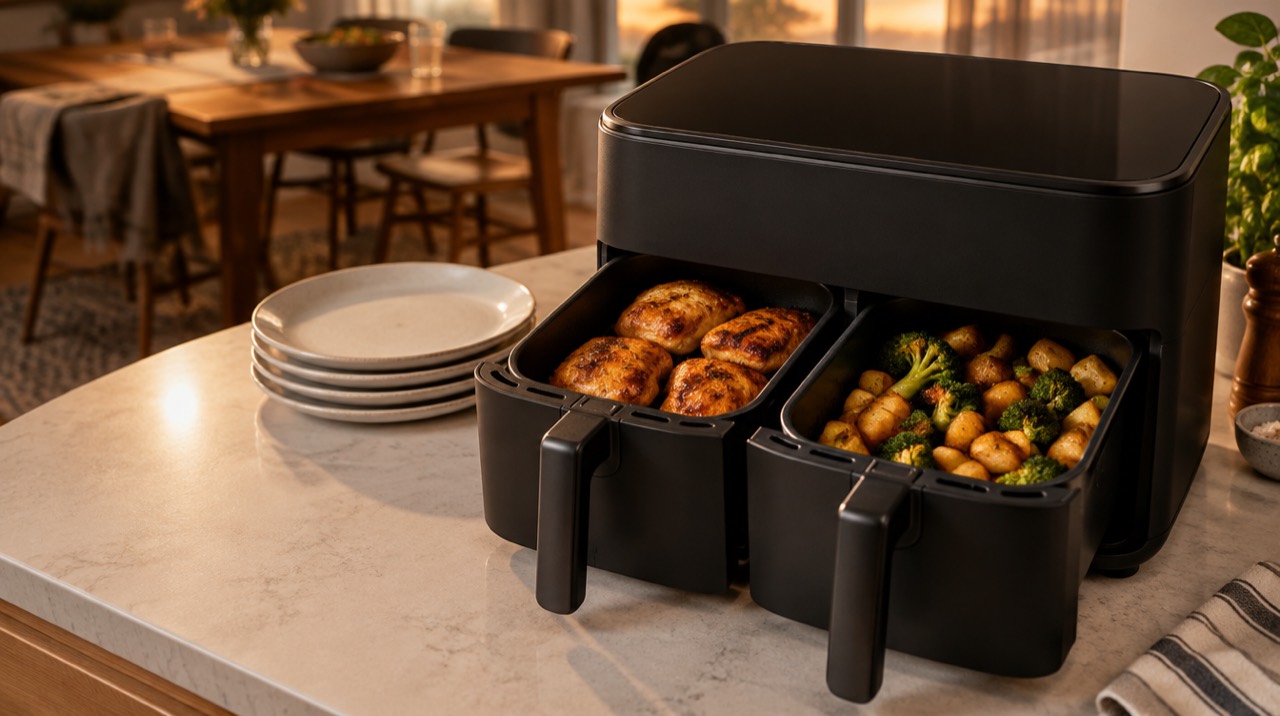
- Dual-basket models run each basket as its own small fryer. Convert each food separately; if one food needs longer, start it first or let the finish-together feature stagger the starts.
- Air fryer toaster ovens and oven-style units have a larger cavity and food further from the fan, so they usually land closer to the oven time. Start with the 25°F drop but cut the time by less, perhaps 10 to 15 percent, and check.
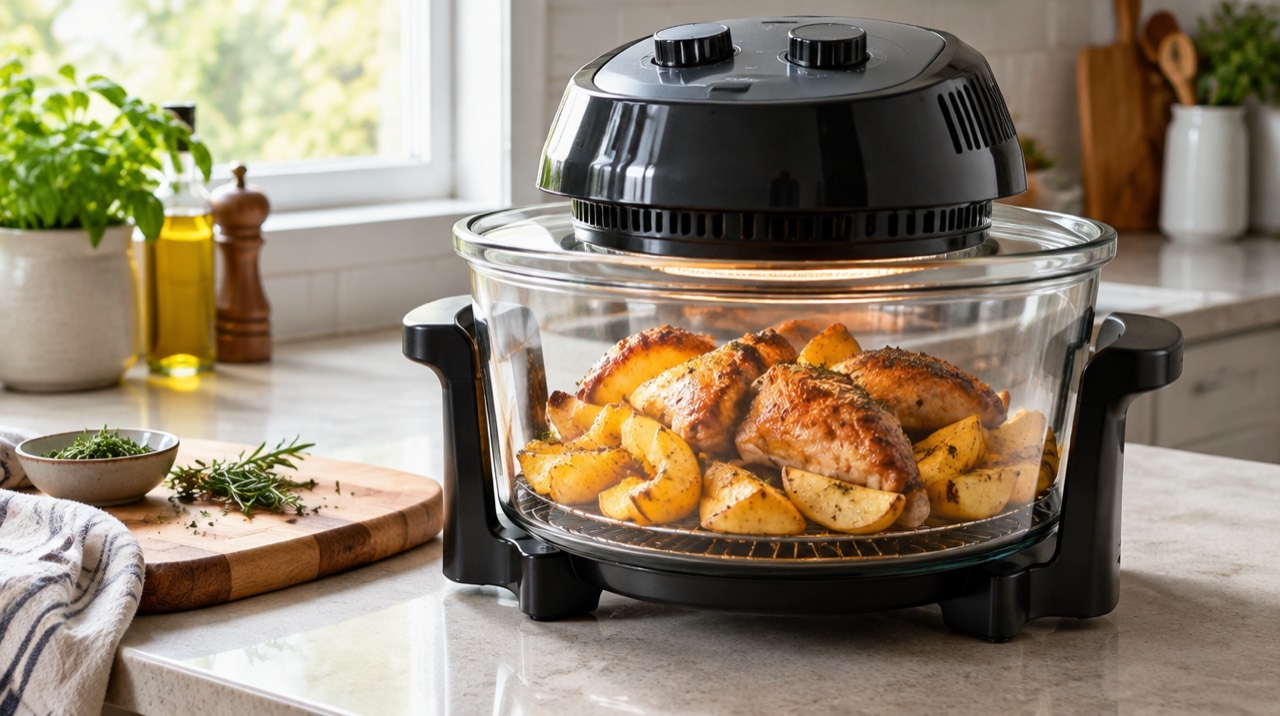
- Glass bowl and glass container fryers let you watch browning, which helps on a first conversion, but a thick glass vessel can take longer to heat than a thin metal basket. Treat the converted time as a minimum rather than a maximum, and still confirm with a thermometer.
Adjusting for a full basket or a big batch
Conversion rules assume a single layer with space around each piece. When you scale an oven recipe that served six into one basket, three things happen: air cannot reach the middle, the food steams, and the time stretches. Two short rounds usually beat one crowded one. Keep the first batch warm in a low oven, or recrisp it in the air fryer for a minute or two at the end. If you split batches every night, the basket is too small for your household; our size table helps you pick the next size up.
Converting back: air fryer to oven
Reverse the rule: raise the temperature about 25°F and add about 25 percent to the time (the inverse of a 20 percent cut), then check by temperature. Spread food on a sheet pan in one layer so it still browns.
Mistakes to avoid
- Using oven time unchanged. Food overbrowns outside and may still need checking inside.
- Filling the basket like a casserole dish. Split into batches; a bigger unit helps, see best air fryer for a family of four.
- Trusting color. Glass bowls and windows show browning, not safety; see the best glass air fryer guide.
- Skipping the thermometer for meat, poultry, fish and eggs.
Frequently asked questions
How do I convert oven temperature to air fryer temperature?
Set the air fryer about 25°F lower than the oven recipe. KitchenAid's guidance is 25°F below the suggested oven temperature; Instant Brands' UK guidance is 20°C lower, which is about 36°F. Use 25°F for most foods and up to about 50°F lower for things that brown quickly.
How much shorter is air fryer cooking time than the oven?
About 20 percent shorter for fresh food, so a 30 minute oven recipe becomes about 24 minutes. Instant Brands' UK guidance says 20 to 25 percent. Start checking a few minutes early, especially the first time, because air fryers vary.
How do I convert frozen food oven instructions to an air fryer?
Instant Brands' UK guidance for many frozen foods is to keep the oven temperature and cut the time by about half, then shake or turn halfway. Packages that include air fryer directions should be followed first.
Is 350°F in the oven the same as 350°F in an air fryer?
No. The small cavity and strong fan move heat into the food faster, so the same setting browns and cooks faster. That is why the usual starting point is 325°F in the air fryer for a 350°F oven recipe.
How do I know when converted food is cooked?
Use a food thermometer, not the timer. USDA's safe minimum internal temperatures are 165°F for all poultry and leftovers, 160°F for ground meat, 145°F with a 3 minute rest for beef, pork, veal and lamb steaks, chops and roasts, and 145°F for fish.
Keep reading
- What Size Air Fryer Do I Need? Quarts by Household
What size air fryer you need, in quarts, for 1, 2, 4 or 6 people, plus why basket floor area matters more than the number on the box. Spec-based, with a calculator.
Updated Nov 2026 - Best Air Fryer for a Family of Four: Size First
The best air fryer for a family of four: 6 to 6.5 qt single baskets vs 8 to 10 qt dual baskets, compared by real capacity, footprint and power. Spec-based picks.
Updated Nov 2026 - Best Glass Air Fryer: Non-Toxic Picks Compared
The best glass air fryer for you: glass drawer baskets, Ninja Crispi glass containers and big glass-bowl fryers compared by size, heat and what touches food.
Updated Nov 2026